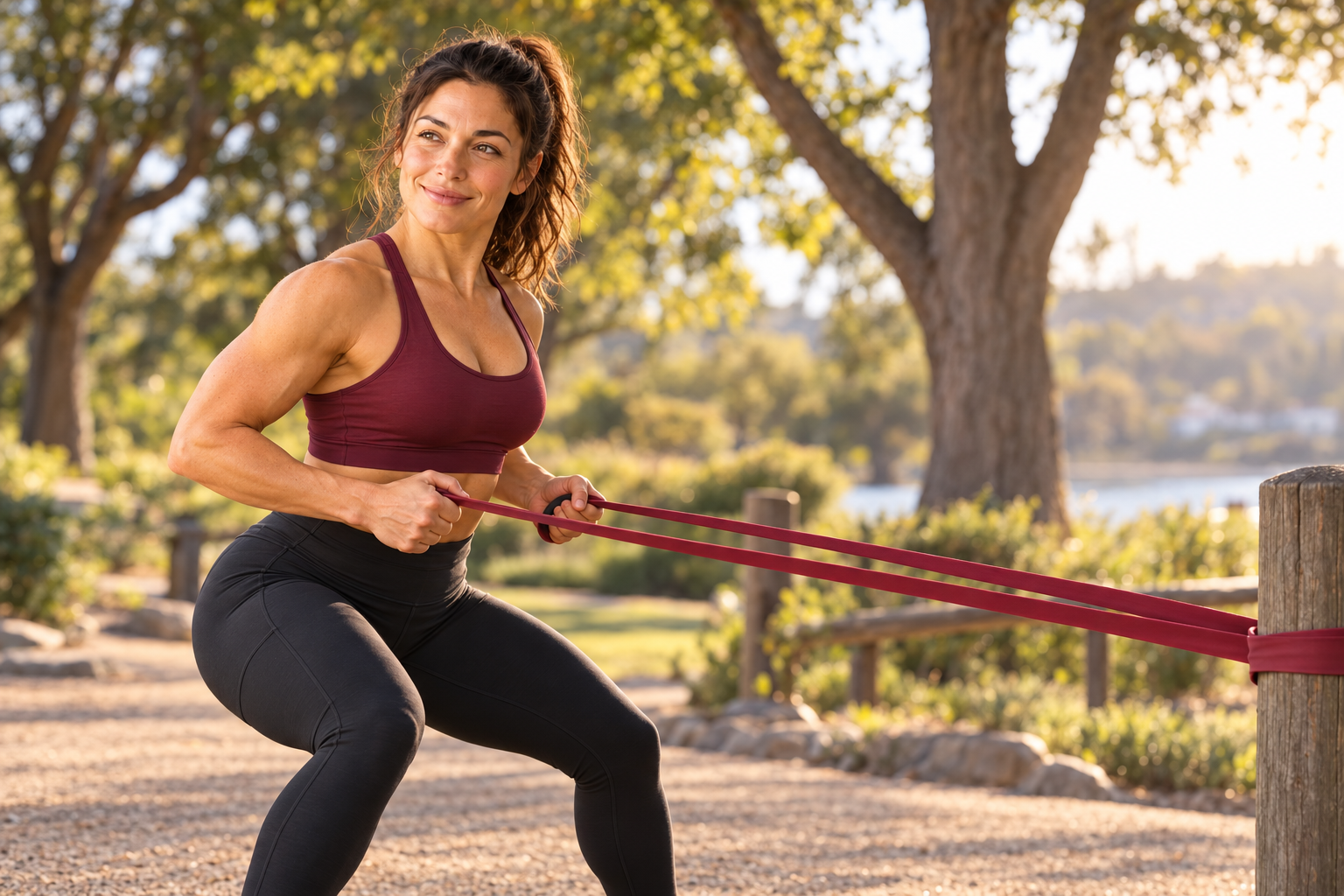
You finish your last set of squats. Same dumbbells as three weeks ago. It felt fine.
Now the internet has opinions. Add weight. Add weight every session. If the weight isn’t going up, you’re wasting your time.
Breathe. That isn’t what progressive overload means, and it isn’t how a beginner needs to train.
Here’s the short version. Progressive overload means asking a little more of your muscles over time. Adding weight is one way to do that. It isn’t the only way, and it doesn’t have to happen every workout.
This guide covers the options, how to tell when you’re ready for the next step, and what to do when things stall. New to strength training altogether? Start with our guide Strength Training for Beginners.
What progressive overload actually means
Your body adapts to what you ask of it. Ask a little more, and it adapts again.
That’s the whole idea. US physical activity guidelines describe overload as doing more than your body is used to. The body responds and adapts, and muscle-strengthening work overloads your muscles in a way that makes them stronger. The American College of Sports Medicine (ACSM) describes progressive overload as increasing the stimulus on the muscle over the course of a training program.
Notice what’s missing from both: a rule about weight. The ACSM’s 2026 review says adding load is one way to support progressive overload, and talks about increasing the stimulus “in some manner.” US guidelines add that small, progressive changes help the body adapt while minimizing the risk of injury.
So the principle is simple. A little more, over time.
Not a lot more, every time.
Do you have to keep making it harder?
Not to get benefits. The ACSM’s 2026 review says progression isn’t necessary to benefit from strength training. Making the work harder is likely needed if you want to keep improving over the longer term.
There’s a beginner twist. If you’re new and your weights have to start low, the same review says progressing becomes a requirement for a meaningful benefit. Many beginners sensibly start light. That’s exactly why stepping up matters.
How far you take it is your call. The ACSM notes that continuing to progress can be a personal decision. Holding steady for a while is a legitimate choice, not a failure.
Before you add anything: own the movement
Before you make an exercise harder, do the current version well.
That means:
- every rep controlled, on the way up and on the way down;
- the full range you can control;
- the last rep looks like the first.
If you’re brand new, it’s fine to practice a movement with no weights or bands until it feels comfortable. The National Institute on Aging suggests exactly that for beginners.
One thing to be clear about. Better form isn’t progressive overload. Neither is more control, or moving through a bigger range. Those tell you whether you’re ready for the next step. The overload is the step itself.
How to do each exercise well is covered in Strength Training Exercises for Beginners.
Ways to make the work harder
US guidelines name several ways to make strength work progressively harder: more weight, more sets or reps, or more days a week. An extra training day counts, but how often to train is covered in Strength Training for Beginners. Here’s how the other options look.
Add reps
Keep the weight. Do one more rep than last time.
This is the gentlest step, and it works with anything: dumbbells, bands, machines, body weight.
One 8-week study compared adding reps with adding weight, in people who had already lifted for at least a year. Both approaches appeared to work. Strength slightly favored adding weight, but the researchers described the difference as of questionable practical significance. It wasn’t done in beginners. Treat it as encouraging, not as proof.
Add weight
Move to the next weight up. Make it the smallest step your equipment allows.

For strength, heavier weights do eventually matter. The ACSM’s review found heavier loads built more strength. That’s why the weight still goes up over time.
Just not every session.
Add a set
If you’ve been doing one set of an exercise, a second set is a real step up. The ACSM advises at least two sets per exercise. Beyond about two or three sets, each extra set adds less for strength. How many sets and reps to do is covered in Sets, Reps and Rest.
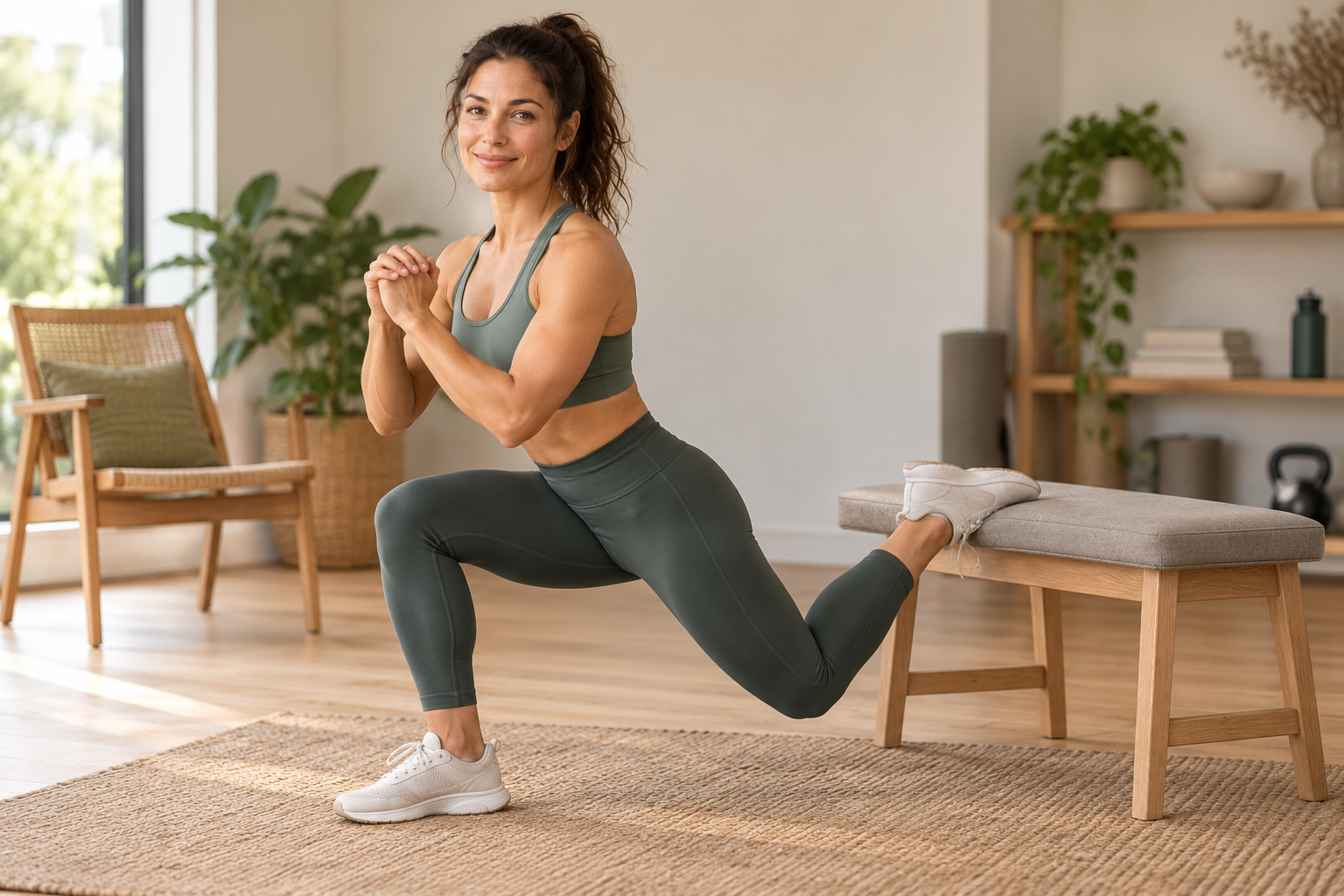
Move to a harder version
With body weight or bands, the next step is often a harder version of the same movement. Strength Training Exercises for Beginners shows the easier and harder versions of each exercise.
What doesn’t need to change
Two more “ways” turn up online: slowing every rep right down, and cutting your rest. You don’t need either to progress. The ACSM’s 2026 review found that time under tension (how long your muscles spend working against the weight) didn’t change strength or muscle size, and rest length didn’t change strength.
Progressing doesn’t mean every set ends in a grind, either. In the same review, pushing sets to failure didn’t improve strength results.
When to step up: reps first, then weight
Here’s one simple way to put this together. It’s PLENTIST’s own method, pieced together from the evidence in this guide. No official body sets it as a rule, and it’s not the only way to progress.
- Work within a rep range. For example 8 to 12, the range explained in Sets, Reps and Rest.
- Add reps first. Keep the same weight until you reach the top of the range on every set.
- Then add weight. Take the smallest step available. Your reps will drop back toward the bottom of the range. That’s expected.
- Build the reps back up. Then repeat.
Here’s how that might look. Say you do two sets of an exercise. This week you manage 9 reps, then 8. A few sessions later it’s 12 and 12, both controlled, with a couple of reps still in the tank. Time to step up. With the next weight, you’re back to around 8, and you start building again.
A practical sign you’re ready
This is the sign we use. It’s practical advice, not a research finding.
You reach the top of your rep target on every set. Your form holds. You still have a couple of reps left. And it happens in more than one session.
One good day is a good day. A repeat is a pattern.
When to keep the same weight
Stay where you are if:
- you’re not yet reaching the top of your range on every set;
- your form slips on the last few reps;
- the exercise still feels new.
That isn’t standing still. It’s the work that earns the next step.
When the next weight is too big a jump
Dumbbells and bands come in fixed steps. Sometimes the next one up is too much.
Don’t force it. Add a rep, add a set, or try a slightly harder version first.
And change one thing at a time. Then you know what made the difference.
How fast? Small steps, not every session
Progress isn’t a staircase you climb every workout.
US guidelines describe a small overload, then time for the body to adapt and recover. MedlinePlus puts it plainly: to build strength, you need to push your body, and the key is to push slowly and gradually.
Think small turns of the wrench, not big ones.
So expect some sessions to move forward and others to match last time. Some sessions will simply feel harder than others. One flat session isn’t a problem. It’s training.
Keep a simple record
You won’t remember last Tuesday’s reps. Nobody does.

Use a notebook or your phone. For each exercise, note the weight, then the reps you got in each set.
Then use it. Before each session, look at last time. That’s your target: match it, or beat it by a rep.
After a few sessions, the record shows a pattern. Reps climbing. Reps stuck. Form getting shaky at the same point. That’s where the step-up decision comes from, not from how you feel walking in.
When progress stalls
Sometimes the numbers stop moving for a while. Before you change anything, check three things.
- Have you been consistent? Missed sessions show up in the record.
- Is your form the same? Extra reps that come from a shorter range or a sloppier movement aren’t progress.
- Was the last jump too big? If you’ve been stuck since you added weight, go back to a weight you control and build the reps up again.
Going back a step isn’t failure. It’s part of the process.
Don’t try to fix a stall by piling on more. More isn’t automatically better. The National Institute on Aging notes that overdoing muscle-strengthening exercise can cause exhaustion, sore joints, and muscle pain or injury.
Still stuck? A qualified exercise professional can look at what you’re doing with you. The ACSM points out that exercise practitioners can offer valuable guidance.
Keep it simple
You don’t need a complicated program to keep progressing.
The ACSM’s review found that with appropriate progressive overload, elaborately planned training cycles weren’t significantly better than simpler programs. It also found that untrained people benefit from many kinds of programs, as long as progression, the key training variables and sticking with it are at the core.
So pick your exercises. Show up. Write it down. Step up when the record says so.
Effort is expected. Pain isn’t. MedlinePlus is clear that you should never feel pain when exercising.
If an exercise causes pain, stop right away. Contact your health care provider about muscle or joint pain that doesn’t go away.
For the next week: pick one exercise. Every session, write down the weight and the reps for each set. At the end of the week, read it back and decide: hold steady, add a rep, or step up.
Sources
- U.S. Department of Health and Human Services. Physical Activity Guidelines for Americans, 2nd edition. 2018.
- Currier BS, D'Souza AC, Fiatarone Singh MA, Lowisz CV, Rawson ES, Schoenfeld BJ, Smith-Ryan AE, Steen JP, Thomas GA, Triplett NT, Washington TA, Werner TJ, Phillips SM. Medicine & Science in Sports & Exercise 58(4):851–872. American College of Sports Medicine Position Stand. Resistance Training Prescription for Muscle Function, Hypertrophy, and Physical Performance in Healthy Adults: An Overview of Reviews. 2026.
- Plotkin D, Coleman M, Van Every D, Maldonado J, Oberlin D, Israetel M, Feather J, Alto A, Vigotsky AD, Schoenfeld BJ. PeerJ 10:e14142. Progressive overload without progressing load? The effects of load or repetition progression on muscular adaptations. 2022.
- National Institute on Aging, National Institutes of Health. Four Types of Exercise Can Improve Your Health and Physical Ability. reviewed 2025.
- MedlinePlus, U.S. National Library of Medicine. How to avoid exercise injuries. reviewed 2024.
This article is for general information and isn’t a substitute for personal medical advice. If you have health concerns, speak to a qualified professional.