You’ve cleared a patch of floor between the sofa and the coffee table. No gym membership. Maybe a pair of dumbbells in a closet, maybe nothing.
Now the questions start. Does this count? Do you need to buy anything? Bands or dumbbells? And what happens when it all gets easy?
Here’s the short answer. You can start strength training at home, often with what you already have. Over time, some things get harder to do without a little equipment, and pulling is the clearest example.
This guide covers what home training can and can’t tell you, what you actually need, how to cover every movement with your setup, and what to do when your setup stops being enough. New to strength training altogether? Start with Strength Training for Beginners.
Can you really get stronger at home?
Yes. The more useful question is how sure we can be, and compared with what.
US physical activity guidelines count your own body weight and elastic bands as resistance. Their list of muscle-strengthening activities includes resistance bands, push-ups, planks and carrying heavy loads. So home training counts.
Does it work? The American College of Sports Medicine’s 2026 review found that training at home improved strength, muscular endurance and balance compared with not training.
Two honest limits come with that. The reviews behind the finding studied older adults. And they compared training at home with doing nothing, not with training in a gym.
So the evidence says home training beats no training. It doesn’t say home training equals a gym, and it doesn’t say equipment makes no difference.
That’s enough reason to start. The rest of this guide is about making the most of it.
What you actually need
Less than you’d think to start. More, possibly, as you go.
That’s the real distinction: starting versus progressing. You can begin some strength training without buying anything. But the options, and how far you can push each exercise, get narrower over time.
Here’s the order we’d suggest if you’re deciding: start with nothing, add a resistance band if you need one, then add dumbbells if you want more. That’s PLENTIST’s practical advice, not a rule from research, and it’s not a shopping list. If you already own dumbbells, start with those.
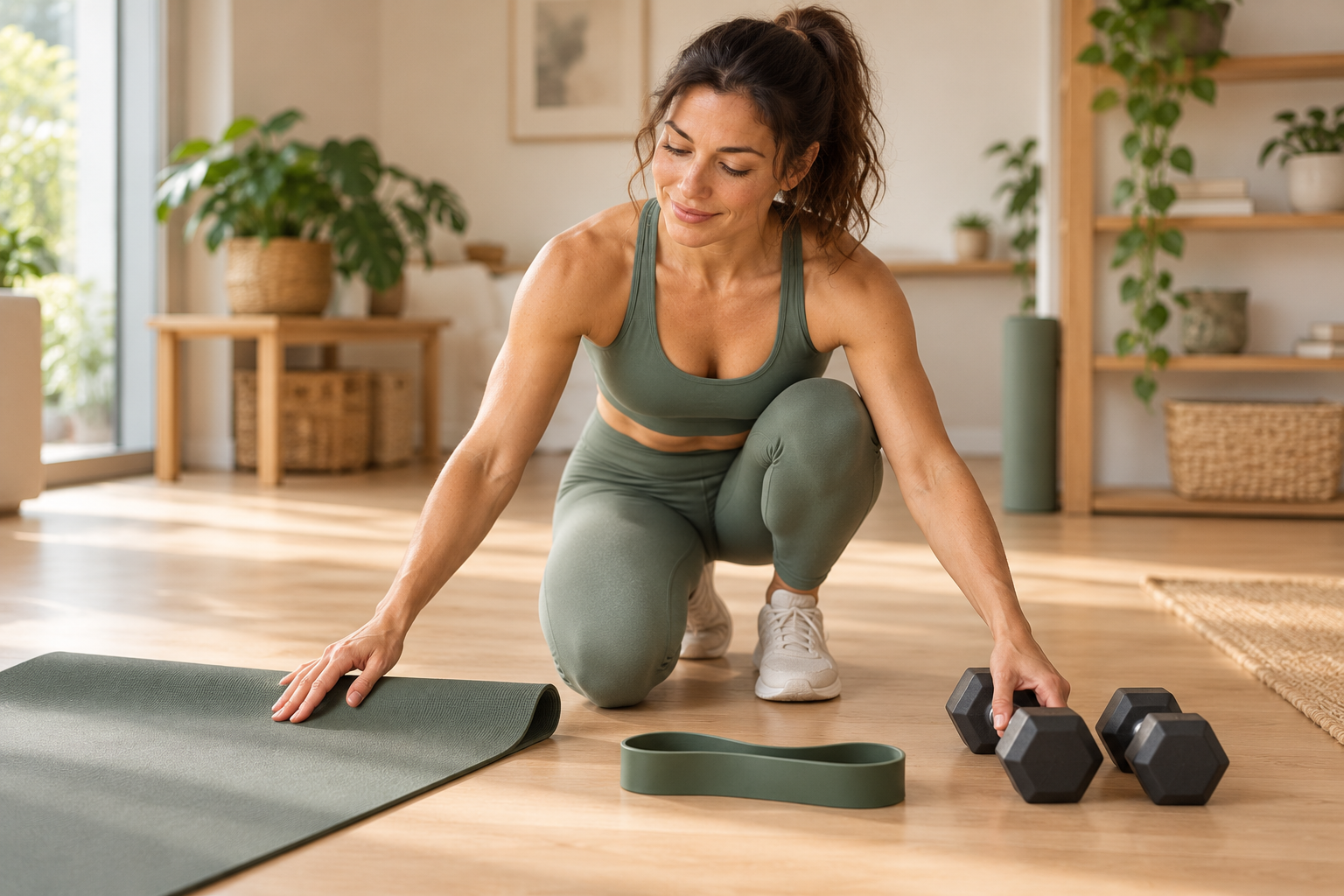
Nothing: your body weight
Body weight is a fair place to start. The National Institute on Aging suggests beginners try exercises without weights or bands until they’re comfortable with the movements.
It has limits, though. The evidence on body weight alone is thin: the ACSM review notes that, in the reviews it covered, body-weight training wasn’t studied as a stand-alone method, apart from one hamstring exercise.
In practice, two things get harder with body weight alone. Pulling is hard to train well. And for some exercises, there’s only so much resistance your own body can add.
A resistance band
A band is small, easy to store, and it gives you a way to pull. In the ACSM review, band training improved strength versus no training at all. It also improved muscle size, in reviews that included older adults.
How does it compare with weights? Two small reviews compared band training with training on weights or machines. For strength, neither came out clearly ahead. One looked at healthy adults; the other pooled studies of different groups of people. That’s strength only, from a limited number of studies. For overall physical function, standard resistance training did better than bands in the ACSM review, and one of the smaller reviews found the same.
So bands are a useful tool, not a perfect substitute for everything.
Dumbbells
Dumbbells give you a clear, measurable resistance, and they cover the hinge, the row and the carry neatly.
There’s no required weight or set to own. Start with what fits your space and what you’ll actually use.
Things around the house
The National Institute on Aging suggests using items you already have, such as books or detergent jugs, for muscle-strengthening work.
Our advice: only use things you can grip securely and that won’t shift or spill. Leave the furniture, doors and anything unstable out of it.
Covering the five movements at home
Strength Training Exercises for Beginners builds a routine from five movement patterns: squat, hinge, push, pull and carry. Here’s what each one can look like with the setup you have.
| Movement | No equipment | With a band | With dumbbells |
|---|---|---|---|
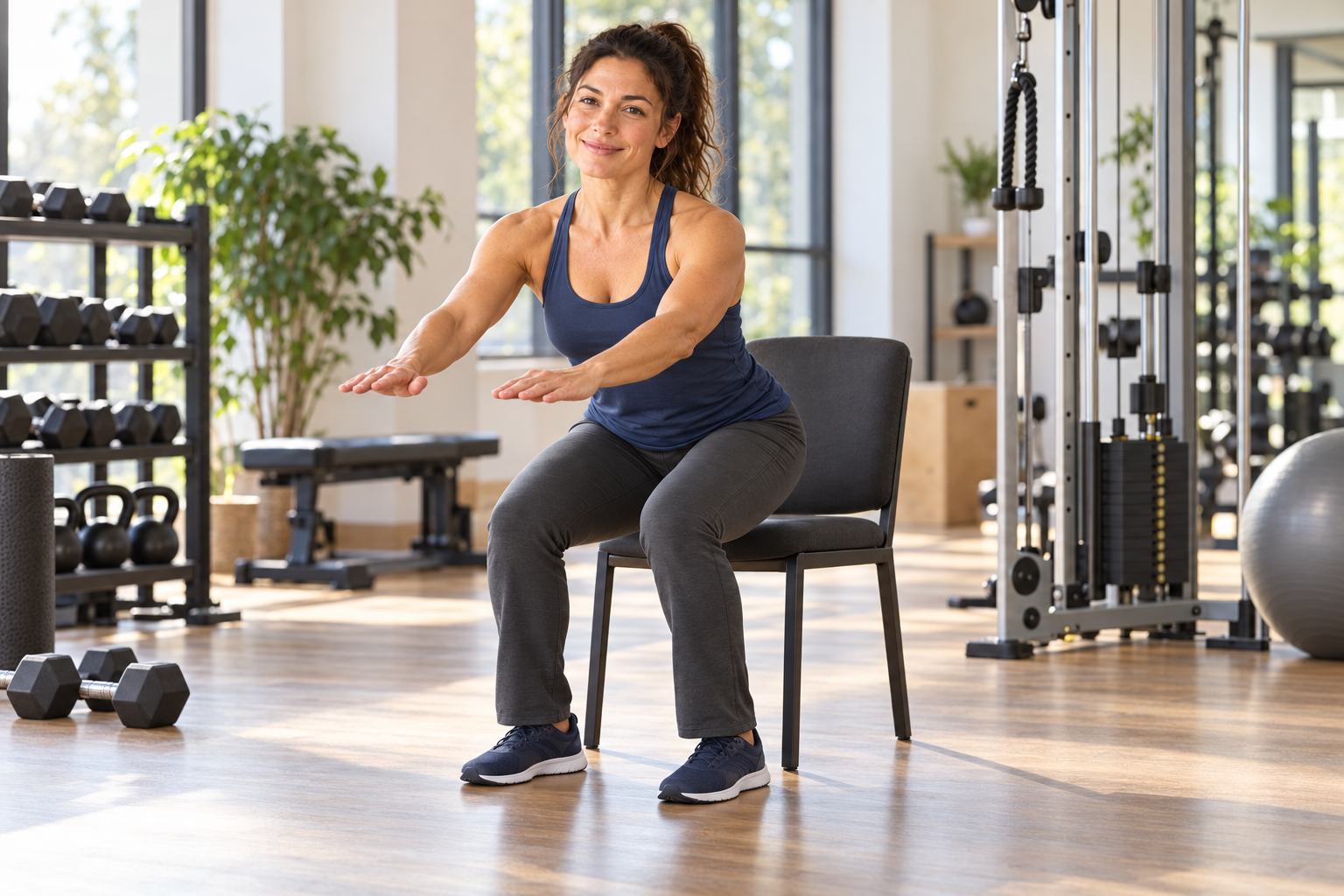
| Squat | Bodyweight squat or chair rise | — | Goblet squat |
| Hinge | Hip hinge with no weight | — | Dumbbell Romanian deadlift |
| Push | Wall push-up, incline push-up on a sturdy bench, or push-up on the floor | — | — |
| Pull | Hard to train with body weight alone | Seated band row | One-arm dumbbell row |
| Carry | Full shopping bags, carried with a firm grip | — | Farmer’s carry |
A dash means the exercise guide doesn’t use that equipment for that movement, not that it’s impossible.
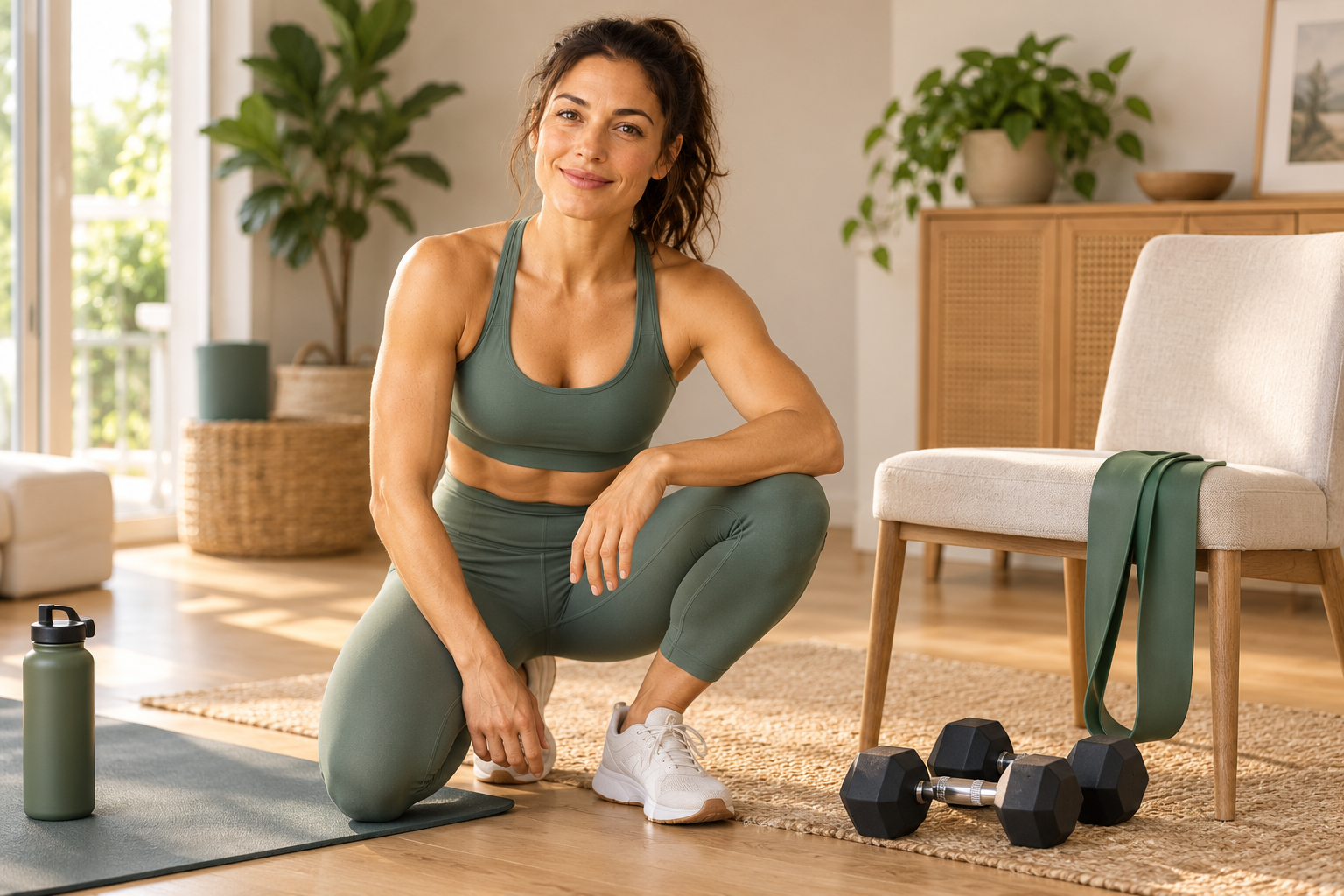
Read the table this way. Four of the five movements have a no-equipment option. Pulling is the gap.
That’s why, if you buy one thing, a band or a dumbbell is the simplest way to cover pulling. We’d skip improvised pulls using doors or furniture.
How to do each exercise, step by step, is in Strength Training Exercises for Beginners.
Setting up your space
US guidelines advise using appropriate equipment and choosing safe places to be active. Here’s how we’d apply that at home:
- Clear floor. Enough room to lie down and to step in any direction without hitting anything.
- A stable, non-slip surface. No loose rugs underfoot.
- Something sturdy. A solid chair that doesn’t roll or fold, if an exercise uses one. The National Institute on Aging suggests having a sturdy chair, a person or a wall nearby to hold on to when you need support.
- Equipment in sight. Keep it where you’ll see it, not buried in a closet.
If you use bands
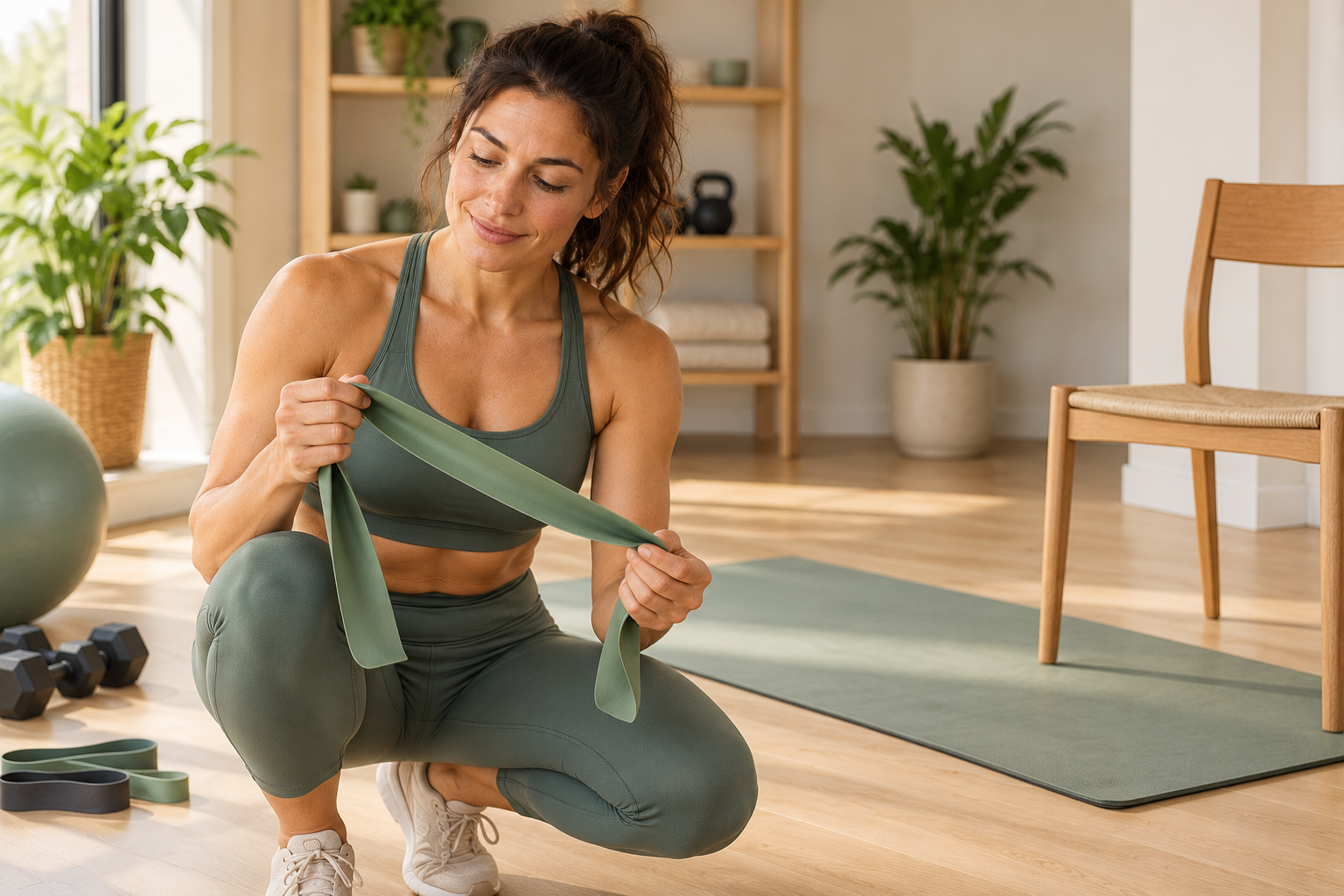
- Check it first. Look for nicks, tears or punctures before you use it, and don’t use a damaged band.
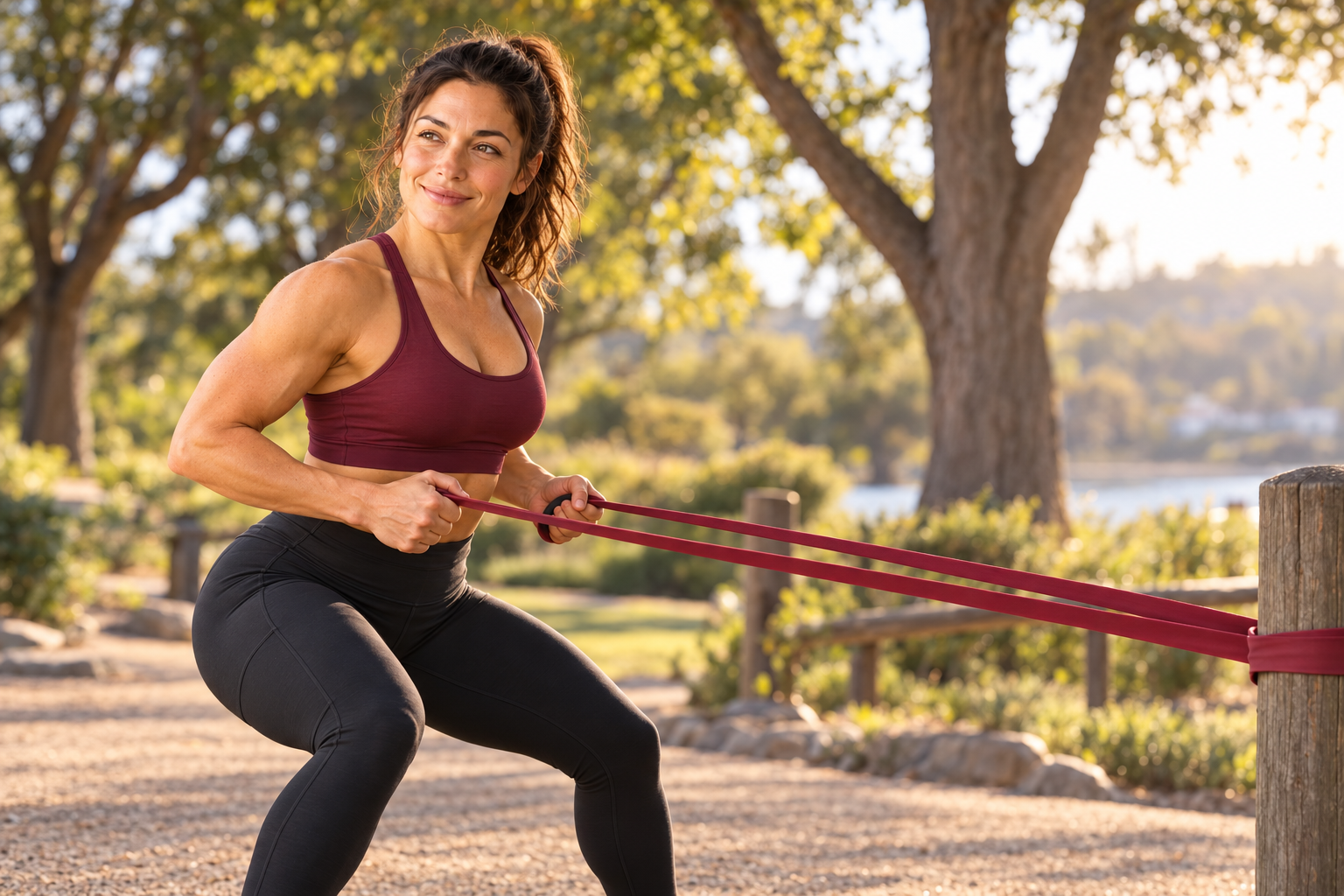
- Hold it at both ends. Keep the band secured at two points, such as in both hands, or under your foot and in your hand. When you stand on it, make sure it’s securely under your shoe.
- Anchor only to something sturdy. An anchored band can slip and spring back toward your face. If you anchor it, attach it to a sturdy object, securely.
- Don’t overstretch it.
A simple home session
This isn’t a program. It’s the beginner’s first-week idea from Strength Training for Beginners, done with what you have at home.
- Warm up. Run through your exercises with lighter resistance or none.
- Pick one exercise for each movement from the table above, using your setup.
- Do your sets and reps as explained in Sets, Reps and Rest.
- Judge effort by feel. With bands and body weight, there’s no number on a dumbbell to go by. Use how hard the last reps feel, as Sets, Reps and Rest describes. The ACSM review notes that this kind of effort-based approach could work for band and body-weight exercises.
- Write it down. Exercise, version or resistance, and reps.
That’s it. Five movements, your equipment, a note at the end.
When your home setup gets too easy
This is the real home-training problem. A gym has a heavier weight on the next rack. Your living room might not.
When your hardest option starts to feel easy, you still have moves to make:
- Add reps.
- Add a set, where that fits the guidance in Sets, Reps and Rest.
- Switch to a harder version of the exercise.
- Add resistance. With a band, changing how much slack it has changes how hard the exercise is. With dumbbells, it means a heavier weight, in the smallest step you have.
How and when to make each change is covered in Progressive Overload for Beginners.
At some point, more resistance matters. For strength specifically, the ACSM review found heavier loads built more strength. That’s when another band, heavier dumbbells or some time in a gym may be worth considering. It’s an option, not a requirement.
One more home-specific point. A review of home-based strength training in older adults found the improvements were generally small. Its authors suggested one possible reason: with less supervision or less motivation, people might not have pushed the difficulty up enough. At home, nobody nudges you. Your notes have to.
Learning good form on your own
You don’t have a coach watching. That’s fine. You have options.
The National Institute on Aging suggests booking one or two sessions with a personal trainer, or joining a group class, to learn proper form. It also notes that free online videos showing specific exercises can help.
One practical tip from us: film a set on your phone, or use a mirror, and compare what you see with the exercise guide. It won’t catch everything, but it shows you things you can’t feel.
If an exercise causes pain, stop right away. Contact your health care provider about muscle or joint pain that doesn’t go away.
This week: clear your spot. Make a list of what you have, even if it’s just a chair and a couple of shopping bags. Then match one exercise to each of the five movements. Where there’s a gap, write it down. That gap is your first decision.
Sources
- U.S. Department of Health and Human Services. Physical Activity Guidelines for Americans, 2nd edition. 2018.
- Currier BS, D'Souza AC, Fiatarone Singh MA, Lowisz CV, Rawson ES, Schoenfeld BJ, Smith-Ryan AE, Steen JP, Thomas GA, Triplett NT, Washington TA, Werner TJ, Phillips SM. Medicine & Science in Sports & Exercise 58(4):851–872. American College of Sports Medicine Position Stand. Resistance Training Prescription for Muscle Function, Hypertrophy, and Physical Performance in Healthy Adults: An Overview of Reviews. 2026.
- Thiebaud RS, Funk MD, Abe T. Geriatrics & Gerontology International 14(4):750–757. Home-based resistance training for older adults: a systematic review. 2014.
- de Oliveira PA, Blasczyk JC, Souza Junior G, Lagoa KF, Soares M, de Oliveira RJ, Filho PJBG, Carregaro RL, Martins WR. Journal of Physical Activity & Health 14(4):317–327. Effects of Elastic Resistance Exercise on Muscle Strength and Functional Performance in Healthy Adults: A Systematic Review and Meta-Analysis. 2017.
- Lopes JSS, Machado AF, Micheletti JK, de Almeida AC, Cavina AP, Pastre CM. SAGE Open Medicine 7:2050312119831116. Effects of training with elastic resistance versus conventional resistance on muscular strength: A systematic review and meta-analysis. 2019.
- National Institute on Aging, National Institutes of Health. Exercise and Physical Activity for Older Adults: Staying Active as You Age. 2025.
- MedlinePlus, U.S. National Library of Medicine. How to avoid exercise injuries. reviewed 2024.
- Nebraska Extension, University of Nebraska–Lincoln. Resistance Band Workout (workout handout). 2026.
- Aneurin Bevan University Health Board (NHS Wales), Physiotherapy Service. Safety Advice when exercising with Resistance Bands or Tubing (ABUHB/PIU1332/3). 2024.
This article is for general information and isn’t a substitute for personal medical advice. If you have health concerns, speak to a qualified professional.