You’ve picked your exercises. You’re standing over a pair of dumbbells. Now what: how many times do you lift them, how many rounds, and how long do you wait in between?
Here’s the short answer. There’s no single magic formula. There is a sensible range, a simple way to judge effort, and a starting point you can use today. This guide walks you through all three.
New to strength training? The bigger picture is in Strength Training for Beginners.
Reps, sets and rest in plain words
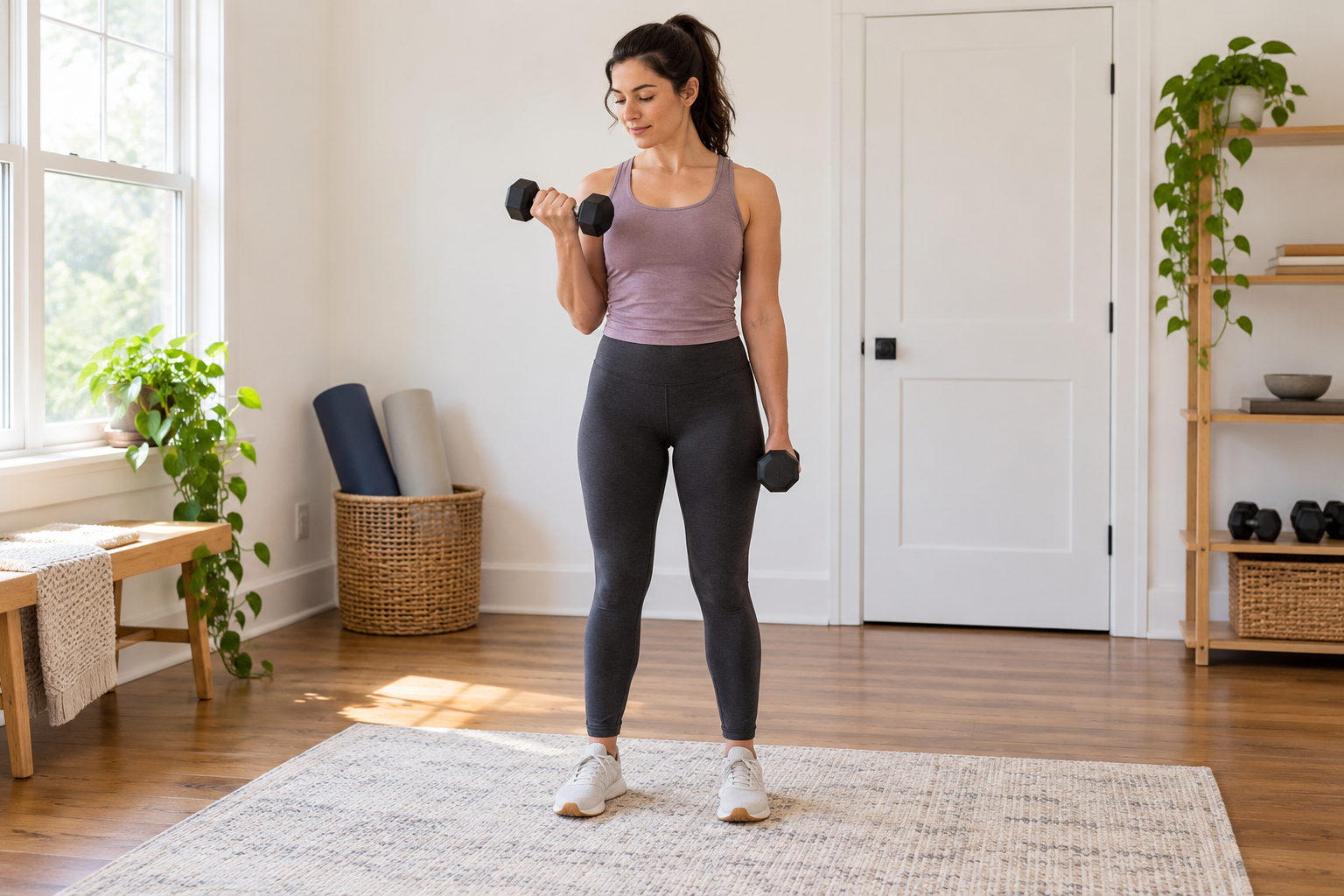
- A rep (repetition) is one full movement of an exercise, such as lifting a weight once.
- A set is a group of reps done without stopping to rest.
- Rest is the pause between one set and the next.
So “2 sets of 10” means: do 10 reps, rest, then do 10 more.
What the guidelines say
The official starting point
US physical activity guidelines, and the CDC’s plain-language version of them, say one set of 8 to 12 repetitions of each exercise is effective, and that 2 or 3 sets may be more effective.
That range is general health guidance. It isn’t the only range that works.
What the newest review adds
In 2026, the American College of Sports Medicine (ACSM) published a position stand that pulled together 137 systematic reviews. On sets, it found that one set is better than none and two sets are better than one. It also said the exact number of sets needed for the best results can’t be pinned down.
The ACSM advises healthy adults to do at least two sets per exercise. More sets may add more, but for strength the extra benefit shrinks beyond about two or three sets per exercise.
The two sources fit together. In practice: one set counts. A second set tends to add more. Past two or three, each extra set adds less, and nobody has found a perfect number.
How hard a set should feel
Why reps alone don’t tell you how hard
“10 reps” sounds specific, but it says nothing about the weight. Ten reps with a dumbbell you could lift 30 times is barely work. Ten reps that leave you with only a couple more in the tank is a real set.
So effort matters as much as the number. US guidelines put it simply: do each exercise to the point where another rep would be difficult. The CDC adds “without help.” The ACSM review’s main recommendation is also to train with high effort, and it notes that high effort can be reached with different loads and different numbers of sets.
You don’t need to go to failure
Training to failure means continuing a set until you can’t complete another rep. The 2026 ACSM review found that going to failure didn’t improve gains in strength, muscle size or power, so it isn’t necessary to get results.
Effort should feel hard by the end of a set. It doesn’t need to feel like a fight to the last inch.
Reps in reserve
“Reps in reserve” is a simple way to judge effort. At the end of a set, ask: how many more reps could I have done with good form? That number is your reps in reserve.
The ACSM review describes stopping near failure, or with about two to three reps in reserve, as enough effort. It also says there isn’t enough evidence to set exact reps-in-reserve targets. So treat “about two or three left” as a useful guide, not a precise rule.
How long to rest between sets
A practical starting range
For people new to strength training, a 2018 systematic review concluded that rests of about 60 to 120 seconds seem to be enough to maximize strength gains. People with more training experience may need longer than 2 minutes.
So about one to two minutes is a reasonable place to start.
What the evidence says about shorter and longer rests
The 2026 ACSM review found that, for strength, short rests (under a minute) and longer rests (over a minute) gave similar results. The 2018 review also found strength gains are possible even with rests under 60 seconds. For muscle size, the ACSM said there wasn’t enough data to judge the effect of rest time.
That doesn’t mean rest never matters. It means there’s no single perfect number of seconds for everyone.
A simple check
Here’s a practical cue we use: rest until your breathing has settled and you feel ready to do the next set with control.
Circuits and short rests
Some workouts move from one exercise to the next with little rest. That’s called circuit training. It still improved strength and muscle size compared with not training. If you enjoy circuits, they count.
Why the numbers you see online differ
Search “how many sets and reps” and you’ll find 3 × 10, 5 × 5, 4 × 8 to 12, and rest times anywhere from 30 seconds to 5 minutes. Most of that variety comes from three things.
Different goals. The 2026 ACSM review found:
- For strength, heavier weights (ones you can lift fewer times) built more strength.
- For muscle size, lighter and heavier weights gave similar results when the sets were hard, and doing more sets helped.
- For muscular endurance, there wasn’t enough evidence to say how weight or number of sets should change.
Different eras of advice. Older guidance often split numbers by goal. The ACSM’s 2009 position stand suggested a weight you can lift 8 to 12 times for beginners, then different numbers for other goals:
- muscle size: an emphasis on weights you can lift 6 to 12 times, with 1 to 2 minutes’ rest;
- heavy strength work (intermediate and advanced lifters): an emphasis on weights you can lift 1 to 6 times, with 3 to 5 minutes’ rest;
- muscular endurance: light-to-moderate weights for more than 15 reps, with under 90 seconds’ rest.
As the rest section showed, the newer review found short and long rests gave similar strength results.
Different people. The ACSM’s guidance says recommendations should fit a person’s goals, physical capacity and training experience. A plan written for an experienced lifter isn’t written for you yet.
A simple way to start
If you want one place to begin, here’s what PLENTIST suggests. It’s our own practical starting point, built from the guidance above. It isn’t an official prescription, and no single source recommends this exact combination.
- About 2 sets per exercise. At least two sets is the ACSM’s advice, and US guidance says 2 or 3 may be more effective than one.
- 8 to 12 reps per set. This is the range US guidelines use to describe one set.
- About 1 to 2 minutes of rest. This is roughly the 60 to 120 seconds that seemed enough for beginners in the 2018 review.
- Finish each set with roughly a couple of reps left, not at failure. The ACSM review mentions about two to three reps in reserve as enough effort, though exact targets aren’t established.
Before your first working set, do a few reps with a lighter weight or no weight to warm up.
Choose a weight or version where 8 to 12 reps feels hard by the end. For bodyweight moves, see the easier and harder versions in Strength Training Exercises for Beginners.
How often to train is covered in Strength Training for Beginners. US guidelines call for muscle-strengthening activity on at least 2 days a week. What to do when the sets start feeling easy is the job of Progressive Overload.
Small doses can still bring real gains, according to the ACSM review. You don’t need a perfect plan to start.
When to stop a set

Most sets end when you reach your target reps. A few other signals matter too.
- Your technique is starting to slip. Our practical advice: end the set there, even if you haven’t reached your number.
- You’re holding your breath. Don’t. Breathe out during the effort and breathe in as you relax.
- Something hurts. Hard effort and tired muscles are expected. Pain isn’t.
If an exercise causes pain, stop right away. Contact your health care provider about muscle or joint pain that doesn’t go away.
If you have a chronic condition or symptoms, or new symptoms appear as you become more active, the US guidelines recommend involving a health care provider. The safety section in Strength Training for Beginners explains this.
Common questions
Is 3 sets of 10 the right number?
It’s a common default, and it fits inside the guidance above. It isn’t wrong, but it isn’t the one right answer either: the ACSM review couldn’t pin down an exact number of sets. If 3 × 10 suits you, use it. If 2 sets fit your time better, that works too.
Do bodyweight exercises work the same way?
Yes. Count reps and sets the same way, and judge effort with reps in reserve. The ACSM review notes that effort-based methods like this could work for bodyweight and band exercises too. If 12 reps feel easy, pick a harder version of the exercise. If you can’t reach 8 with control, pick an easier one. Strength Training Exercises for Beginners shows both.
Your task this week: for each exercise, at the end of every set, ask yourself how many more reps you could have done with good form. Write the number down. That one habit will teach you more about effort than any formula.
Sources
- U.S. Department of Health and Human Services. Physical Activity Guidelines for Americans, 2nd edition. 2018.
- Centers for Disease Control and Prevention. What Counts as Physical Activity for Adults. 2023.
- Currier BS, D'Souza AC, Fiatarone Singh MA, Lowisz CV, Rawson ES, Schoenfeld BJ, Smith-Ryan AE, Steen JP, Thomas GA, Triplett NT, Washington TA, Werner TJ, Phillips SM. Medicine & Science in Sports & Exercise 58(4):851–872. American College of Sports Medicine Position Stand. Resistance Training Prescription for Muscle Function, Hypertrophy, and Physical Performance in Healthy Adults: An Overview of Reviews. 2026.
- American College of Sports Medicine. Medicine & Science in Sports & Exercise 41(3):687–708. American College of Sports Medicine position stand. Progression models in resistance training for healthy adults. 2009.
- Grgic J, Schoenfeld BJ, Skrepnik M, Davies TB, Mikulic P. Sports Medicine 48(1):137–151. Effects of Rest Interval Duration in Resistance Training on Measures of Muscular Strength: A Systematic Review. 2018.
- National Institute on Aging, National Institutes of Health. Exercise and Physical Activity for Older Adults: Staying Active as You Age. 2025.
- MedlinePlus, U.S. National Library of Medicine. How to avoid exercise injuries. reviewed 2024.
This article is for general information and isn’t a substitute for personal medical advice. If you have health concerns, speak to a qualified professional.